Developing more male contraceptives is about more than just providing men with birth control, it’s about improving the world for everyone.
The lack of accessible male contraceptive options places an unfair burden on women, contributing to the global unintended pregnancy rate of over 120 million globally each year. By expanding male contraceptive choices, we can foster more equitable relationships, reduce the strain on healthcare systems, and promote sustainable population growth. Research consistently demonstrates the positive impact of male contraceptives on individual well-being, family dynamics, and global health.
Family Planning by the Numbers
Expanding access to high-quality contraceptives for all individuals is a critical step toward addressing global challenges. From reducing unintended pregnancies and improving reproductive health outcomes to empowering individuals and promoting sustainable development, the benefits of contraception are far-reaching. Scroll through the images below to discover how contraception is making a positive impact around the world.
Market Demand & Partner Trust |

|
The most persistent questions affecting the research and development of non-hormonal, reversible male contraceptives are: “Do men want these products?” and “Will women in a heterosexual relationship trust their male partners to use birth control?” However, extensive market research has definitively shown that both men and women are eager for more equitable birth control options, domestically and internationally. These findings highlight the growing demand for male contraceptives and underscore the need for continued research and development in this important area.
|
Vision & Mission
|
Our vision of "Reproductive Autonomy for All" is only achievable when individuals have the freedom to make informed choices about their reproductive health. The absence of accessible male contraceptives places an undue burden on women, limiting their reproductive autonomy.
True reproductive autonomy requires a diverse range of contraceptive options for both men and women. By expanding access to male contraceptives, we can promote gender equality and shared responsibilities in family planning and empower individuals to make informed decisions about their lives. Let's work together to build a world where everyone has the power to choose their reproductive future. |
|
Challenges |

|
Developing new drugs is a complex and costly endeavor, with an estimated research and development cost of nearly $1 billion per product. Unfortunately, male contraception has historically been underfunded and under researched. Additionally, many people mistakenly believe that there is no demand for male contraceptives, and pharmaceutical companies often prioritize other areas of research. Supporting organizations like MCI is crucial for advancing male contraceptive research and development. By providing essential funding and resources, we can help overcome these obstacles and bring innovative new options to market.
|
Male Contraception & the SDGs
|
The United Nations Sustainable Development Goals (SDGs) outline a vision for a more just and equitable world. The 17 Sustainable Development Goals were set up by the United Nations as a blueprint to achieve a better and more sustainable future for all. No matter the sustainability issue, it can be improved or outright addressed with new methods of male birth control. Investing in male contraception is an investment in a sustainable future for all.
|

|
LGBTQIA+ Considerations |

|
As we develop the next generation of contraceptives, it is imperative to acknowledge the diverse range of individuals who may benefit from these options. Approximately 5% of young adults in the United States identify as transgender or nonbinary, highlighting the importance of moving beyond traditional gender binaries.
By designing contraceptives with inclusivity in mind, we can ensure that a wider range of people have access to safe, effective, and personalized options that meet their unique needs and preferences. This includes considering factors such as gender identity, sexual orientation, and individual health concerns. |
Personas
|
When developing sperm-targeting contraceptives, it's essential to recognize the diverse needs and preferences of potential users. These needs can vary based on factors such as gender identity, sexual orientation, relationship status, and personal values. "Personas" are valuable tools for understanding our target audience on a deeper level. By creating fictional characters who represent different user groups, we can empathize with their unique perspectives and identify key pain points and desires. This insight allows us to design contraceptives that are not only effective but also tailored to individual needs, ensuring greater user satisfaction and adoption.
|

|
Sign up to learn more!
Join our community of advocates and researchers by subscribing to the MCI monthly newsletter. Stay up-to-date on the latest breakthroughs in male contraception research, learn about upcoming events, and discover ways to get involved. Sign up now and receive valuable insights delivered directly to your inbox each month!
Frequently Asked Questions (FAQs):
About us
Male Contraceptive Initiative (MCI) is a 501(c)3 nonprofit whose objective is to advocate for and promote the development of reversible non-hormonal male contraception. MCI was founded in 2014 by a group of interested individuals who saw a philanthropic model as an innovative method to promote the development of male contraceptives. Since then, we have grown in scope and capacity, funding over $5M in research activities since our inception. Our Executive Board comprises experts in medicine, research, contraceptive development, and marketing, and we retain key advisors and stakeholders in the contraceptive research space.
MCI’s vision is “Reproductive Autonomy for All” and our mission is “To empower men, and couples, to fully contribute to family planning goals by providing them the resources they need for reproductive autonomy.”
We fund scientific studies, support early-stage researchers, and engage with the public on why male contraception will yield an advanced and as yet, unimagined modern landscape that:
We are funded through private donations from people like you. Join us on our journey to make “Reproductive Autonomy for All” a reality!
MCI’s vision is “Reproductive Autonomy for All” and our mission is “To empower men, and couples, to fully contribute to family planning goals by providing them the resources they need for reproductive autonomy.”
We fund scientific studies, support early-stage researchers, and engage with the public on why male contraception will yield an advanced and as yet, unimagined modern landscape that:
- Provides men with an option that is safe and reversible;
- Increases access and contraceptive choices for all;
- Enables informed choice about family growth and planning;
- Offers a complete menu of options for contraception;
- Fosters shared responsibility between spouses and partners;
- Reduces stress on the climate and environment; and
- Provides a solution for a heretofore unaddressed need
We are funded through private donations from people like you. Join us on our journey to make “Reproductive Autonomy for All” a reality!
What sort of products are in development?
Male contraceptives of the future can take a number of forms, with a wide range of product characteristics. This could be a daily pill, an implant, or even a coitally-dependent method that is taken only just before sex.
We like to think of male contraceptives in development as coming in three categories.
We like to think of male contraceptives in development as coming in three categories.
- Vas-occlusive devices. These can be likened to a vasectomy, and block the passage of sperm through the vas deferens. Unlike a vasectomy, these devices are intended to be reversible, and act long-term.
- Drug-based non-hormonal male contraception. This area is a very broad topic, and includes multiple targets with multiple mechanisms of action. Products could take the form of pills, implants, gels, or other modes of delivery. Depending on a number of factors, non-hormonal male contraceptives could potentially be short-acting, or quite long-acting, and there are many projects in development that span these diverse potential product characteristics. MCI focuses our funds on methods like vas-occlusive devices and drug-based non-hormonal approaches.
- Hormonal male contraception. This method uses administration of exogenous hormones to shut down sperm production, and is in active development with governmental and other support.

|

|

|

|
When will it hit the market?
Science has intended to get male contraceptives on the market for decades. Of the products currently in development, current estimates are 15-20 years away for a drug-based product and 5-10 years away for a device.
Listen to Intended, a new podcast from us where we discuss male contraception--learning from the past, talking to the researchers of the present, and the users of the future.
Listen to Intended, a new podcast from us where we discuss male contraception--learning from the past, talking to the researchers of the present, and the users of the future.
Why do you only support non-hormonal efforts?
Hormonal male contraceptives are currently in clinical trials, with support from the NIH and other funders. Non-hormonal male contraceptives are comparatively underfunded, despite offering a greater opportunity for innovation and methods that meet the needs of more users. MCI supports non-hormonal, early-stage research efforts, investing in the long-term to create an eventual menu of options for men and women that meet their lifestyle and individual needs. We believe that all methods of contraception are meaningful components of a continuum of reproductive care necessary to provide everyone with the autonomy to decide what’s best for them and when.
What happens with the research you fund?
MCI strives for transparency in all our efforts. Our grantees publish their results as Open Access so that the broader community can learn about the latest advances in male contraception. Consistent with our global mission, we also promote access to the eventual products for communities worldwide.
Will men actually use it?
|
There are multiple studies that show the majority of men are interested in male contraceptives, and want the ability to use them. MCI’s own research suggests a potential market of 17 million men in the United States alone. And that’s now – before there are any methods on the market at all. Once it becomes a normal conversation for men to be involved in contraception, we expect that more and more men will be interested.
|
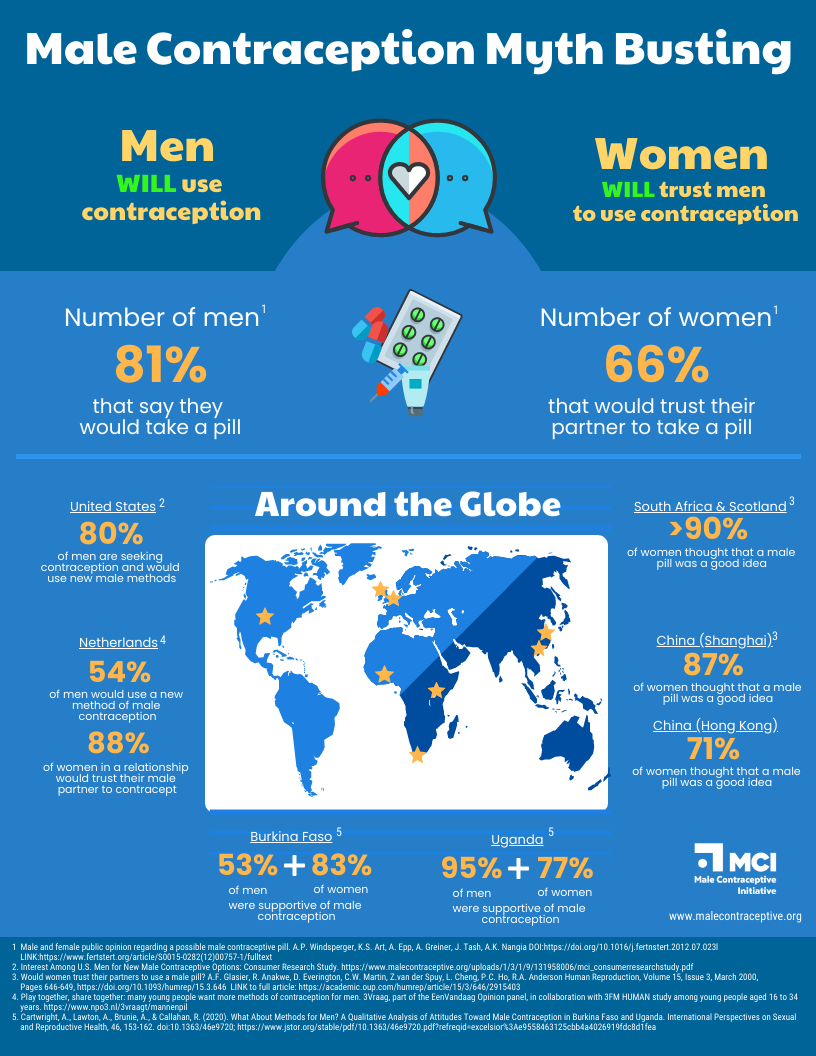
Male Contraception Myth Busting
|
Will women trust men to use it?
|
Male contraceptives will allow new options for couples who find the current landscape doesn’t meet their needs. In surveys, most women would trust their partner to use male contraceptives. Male contraceptives will add to the method mix, providing new options that allow men and women to contribute in whatever way they deem appropriate to contraceptive use. Those who wish to continue using current forms of contraception will still have that option, and each situation will be unique to the individual.
|
Male Contraception Myth Busting
|
Why has it taken so long?
|
The unfortunate saying goes – “Male contraception has been 10 years away for the past 50 years.” There are many reasons for these delays including scientific hurdles, financing, and public interest. However, the field is more exciting than it’s ever been. Research is progressing down previously unexplored pathways with new technological advances, and an increasingly vocal contingent of men and women are highlighting the need for new options.
Our podcast Intended investigates the past, present, and future of male contraception. Season 1 is currently available and its episodes provide details as to why we don’t yet have contraceptive methods for men beyond the condom and vasectomy. |
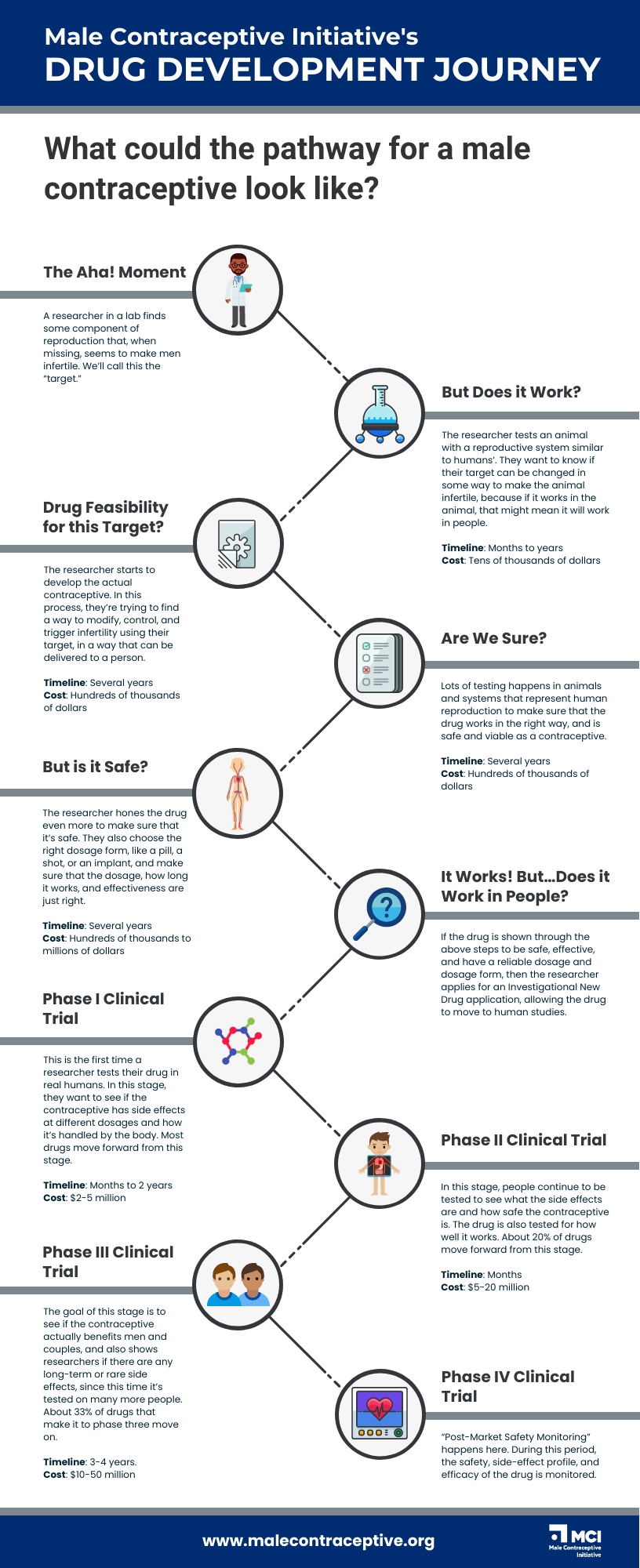
Drug Development Pathway
|
What are the biggest hurdles to making a male contraceptive?
First and foremost, funding. It can cost well over a billion dollars to get a drug all the way onto the market, and in an age where funding is scarce, male contraception rarely makes it to the top of the priority list. MCI pushes projects further along the pipeline to de-risk them and provide incentive for other funders to participate in the landscape.
Secondly, the regulatory pathway for male contraceptives is uncertain. These products will be unlike any other, and the steps required to ensure their safety and efficacy are yet-to-be determined. Male Contraceptive Initiative works with researchers and other stakeholders to clarify that regulatory path, and ask the important questions early. Other hurdles include the scientific challenges inherent in making a safe, reversible contraceptive that meets high clinical standards, and eventual policy issues in making it available for the consumer.
Secondly, the regulatory pathway for male contraceptives is uncertain. These products will be unlike any other, and the steps required to ensure their safety and efficacy are yet-to-be determined. Male Contraceptive Initiative works with researchers and other stakeholders to clarify that regulatory path, and ask the important questions early. Other hurdles include the scientific challenges inherent in making a safe, reversible contraceptive that meets high clinical standards, and eventual policy issues in making it available for the consumer.
What do you think about hormonal male contraception?
We’re very optimistic about hormonal male contraceptive trials, as they will allow men to participate in the family planning process in a way they haven’t been able to before. These eventual products will also create data about what men use, need, and enjoy about contraception, and shape how we guide the innovative products of the future.
Will male contraceptives offer STI / STD prevention?
Simply due to technology, first-generation male contraceptive products aren’t expected to offer sexually-transmitted infection / disease (STI) prevention. Multipurpose prevention technology (MPT) products are a class of products currently being researched to deliver contraception and varied combinations of HIV prevention and other STI prevention. We’re hopeful that innovative future products for men and women will find ways to incorporate these features.
Will women continue using their own contraception?
Many women use hormonal contraception for reasons other than preventing pregnancy. This is an individual choice for women to make on a case-by-case basis, considering their contraceptive needs, relationship, and other factors. We view contraception not as an “either, or” situation, but rather an “and” one: everyone should have access to the contraceptive methods they want and need. It is to everyone’s benefit that people have the tools and resources necessary to achieve their reproductive autonomy.
What are the differences between creating male and female methods?
|
There are lots of differences between developing male and female contraceptive options. Existing female contraceptives generally rely on using active pharmaceutical ingredients (APIs) that have already been approved by the Food and Drug Administration (FDA). This makes their approval and release easier, since much more is known about the safety and efficacy of the drug. Male options are yet to be developed, especially non-hormonal contraceptives. These drugs will need to be fully tested and vetted before they are allowed on the market.
In addition, biology is quite different. Female hormonal contraceptives generally work by preventing ovulation, thickening cervical mucus, and thinning the lining of the uterus. Male contraceptives will need to target the creation or maturation of sperm, it’s transport out of the male reproductive system, or it’s ability to swim to and fertilize an egg. These drastically different biological functions are complex, and need in-depth scientific study to understand how we might block them in a targeted, non-systemic way. |

Existing Contraceptive Methods
|
How can I learn more about conferences and other events around the male contraception space?
We regularly update our Events page to provide you listings of local and international conferences and meetings. This page also gives you access to brief event descriptions along with logistical details. You can sign up for our newsletter to receive information on upcoming events.
Does Male Contraceptive Initiative have published works?
Male Contraceptive Initiative has completed several projects that have led to publication of scientific literature and in general media. Many of these studies and reports are self-published. We also highlight scientific articles that our grantees have published. These resources can be found on our Publications page.
Is there a place where scientific terminology and/or phrases are defined and explained further?
The Glossary provides you quick access to a collection of defined scientific terms and phrases. It also includes words from popular culture in reference to the male reproductive system. You can also visit our videos and webinars, as well as our blog for more in depth explorations of these concepts and terminologies.
Where can I sign up?
You can sign up for our newsletter below for updates on MCI. We’ll notify you of new ways you can participate in the creation of methods for men as we have them.
Reproductive rights are in peril. Now more than ever, we need your support to protect this fundamental human right.
Support our vision of "Reproductive Autonomy for All".
Support our vision of "Reproductive Autonomy for All".
What are the male birth control research activities MCI is supporting?
Discover how your support is making a difference. This section highlights some of the innovative projects we're funding to advance male contraception research and improve access to reproductive healthcare.
A single injection that ensures a man cannot cause a pregnancy for years and is completely reversible.

|
Our grantee Contraline has invented a proprietary hydrogel called ADAM™ that is implanted into the vas deferens through a minimally invasive, outpatient procedure.
The hydrogel works by blocking sperm from traveling through the vas deferens. Similar to intrauterine devices (IUDs) for women, Contraline’s contraceptive is designed to last for years and be reversible. MCI’s support will be used by Contraline to prepare for filing with the FDA and initiating first-in-human trials. |
A reversible male birth control that impacts the head of the sperm, preventing it from fertilizing an egg.
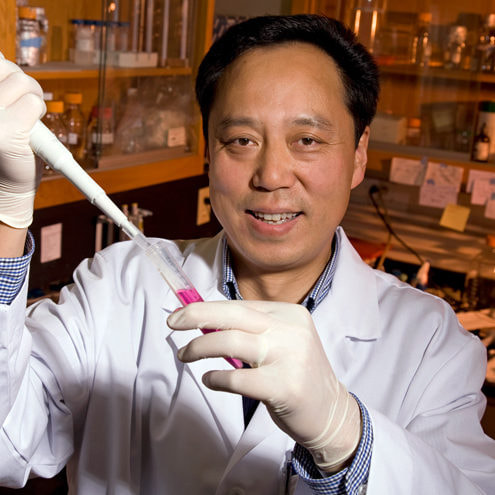
|
Our grantee Dr. Wei Yan and his team of researchers have developed a new compound derived from a Chinese herb called the Thunder God vine (Tripterygium Wilfordii Hook F).
The compound works by causing the head of sperm to be malformed such that they are not able to connect with and fertilize a female egg. This effect only occurs while the compound is consumed, and normal function is fully restored after discontinuing use. MCI’s support allowed Dr. Yan and his team to explore the effects of the compound and publish their results. Because of MCI’s grant, our sister organization Contraceptive Accelerator Network is performing nonclinical studies on Triptonide that advance it towards human studies. |

|
Our grantee Dr. Mario Buffone has been working in the field of sperm physiology for two decades. His lab seeks to understand the complex process of mammalian sperm capacitation, the change sperm undergo in the female reproductive tract that enables them to penetrate and fertilize an egg.
Dr. Buffone is working to screen and identify drugs that are able to prevent the capacitation and therefore render sperm incapable of fertilizing an egg. MCI is supporting the Buffone lab’s studies with the intent of moving towards in vivo preclinical studies. |
A biodegradable implant injected just below the skin’s surface that can deliver a male contraceptive over a sustained period of time.

|
Our grantee Dr. Rahima Benhabbour designs and fabricates delivery platforms for HIV prevention, cancer treatment, and contraception.
Dr. Benhabbour launched her first start-up AnelleO, Inc. in 2016, focusing on developing 3D-printed intravaginal rings for the treatment of infertility. MCI’s support will help facilitate studies that develop and implement an injectable device that can carry drug and translate into human studies. |
A daily, or even on-demand, method of male birth control that prevent sperm from being able to swim when taken.

|
Our grantee Dr. Gunda Georg’s group has published over 200 scientific articles on the design, synthesis, and evaluation of biologically active agents. In addition to male contraception, her lab investigates areas of cancer and female contraception.
Dr. Georg's lab has focused on investigating the testis-specific serine kinase (TSSK) family. These proteins are expressed after sperm have been developed, and are likely involved in multiple steps that could make them excellent contraceptive targets. MCI’s support will help Dr. Georg’s team investigate the sperm-specific isoform of Na,K-ATPase, which is crucial for sperm motility (e.g., sperm’s ability to swim). |

|
Our grantee Dr. Mike O’Rand is the President and Chief Scientific Officer of Eppin Pharma, named after the protein EPPIN which is a critical component of sperm development.
Dr. O’Rand is developing a compound called EP055, a small organic compound that that targets EPPIN on the surface of sperm and prevents sperm from swimming. MCI’s support will help support Dr. O’Rand Investigational New Drug (IND)-enabling milestones that are required for Eppin Pharma to begin the process of entering first-in-man studies for EP055. |
A reversible male birth control method that causes sperm to become sterile.

|
Our grantee Dr. Stephen L’Hernault and his lab have worked on spermatogenesis (i.e., sperm creation) and fertilization for over 30 years.
Dr. L’Hernault is working on developing compounds that can block the function of the IZUMO1 protein, which is required to fertilize an egg. MCI’s support will help Dr. L’Hernault’s team to identify small compounds that reversibly block the function of the IZUMO1 protein. |
A cohort of excited young researchers motivated by curiosity, ambition, and the social good associated with male birth control.
|
Our Fellowship program features a mix of graduate and postdoctoral trainees, all working towards creating non-hormonal, reversible male contraceptive methods.
Our Fellows work on a diverse portfolio of projects that help move the male birth control forward. Our support allows our distinguished Fellows to focus on the research, publish data, and build the background they need to sustain a long career as an investigator. |
An on-demand method of male birth control that you take just before sex.
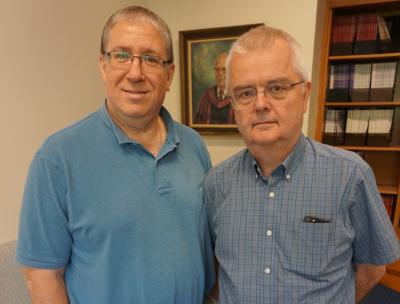
|
Drs. Lonny Levin and Jochen Buck are professors at Weill Cornell Medicine and are working on inhibitors of soluble adenylyl cyclase (sAC) as on-demand male contraceptives. Their deep expertise in sAC keeps them attuned to the effects of inhibitors on sperm functions such as motility.
MCI is supporting work that develops novel inhibitors of sAC as on-demand male contraceptives as well as translational research that assesses the pharmacodynamics of inhibitors on human sperm. These steps are crucial to understanding how the drug stays associated to sperm after ejaculation and its potential contraceptive efficacy. |
What are MCI's advocacy efforts to support male birth control?
Learn about our advocacy and outreach initiatives to raise awareness of the importance of male contraception and drive progress in this critical area.
Working to understand needs and perceptions to develop a menu of male contraceptives that meets everyone’s needs.

|
Our grantee Planned Parenthood North Central States (PPNCS) provides health care to nearly 115,000 people and health education to more than 99,000 people across a five-state region (Iowa, Minnesota, Nebraska, North Dakota and South Dakota) in the United States.
With MCI’s support, PPNCS will engage in critical market research activities by using mixed methods surveys to engage critical stakeholders on their reproductive health needs and desires in hopes that this will help inform research and product development activities. |

|
Outsight4Development, Alstonia Impact, and DesireLine conducted a robust market research study across 7 distinct markets around the world to develop an understanding of the demand for male contraception, men’s interest in and preferences for novel forms of male birth control, and the level of trust that female partners have in their male partners to use birth control. Funding for the male respondent research was supported by funding from the Bill & Melinda Gates Foundation. The Male Contraceptive Initiative provided funding to cover female partners of male respondents.
Findings from this nationally/regionally representative study show that there is significant interest for novel male contraceptives among men and women. Men have interest in trying a new male contraceptive within a year of its availability, and higher interest in trying a new male contraceptive at some point. Female partners surveyed have high trust in men taking contraception, and have high interest in male partners taking contraception. |
|
Our Consumer Research Study was the largest survey in the United States in the past decade exclusive to sexually active men ages 18-44 and focused on developing a better understanding of their attitudes, needs and motivations regarding the future of male birth control.
Developing a keen understanding of the family planning interests of communities domestically and internationally is a critical component of our market research activities. Our support of market research activities helps our grantees better understand the needs of those they’re developing contraceptives for, while framing the demand for male birth control methods in the general public. |
Supporting men and women preventing pregnancy as a unit.
|
Our Shared Risk publication advocates for creating a new ethical framework for assessing risks and benefits for new forms of male birth control.
Currently, the risks associated with pregnancy focus solely on the physical. As women are the only ones capable of physically bringing a baby to term, current thinking prevents a fair assessment of the risks men face when it comes to pregnancy. Our work is a necessary step towards reframing the concept of risk such that it creates a mandate for providing more and better male birth control methods. |
Facilitating a commercial pathway for male contraception driven by collaboration, transparency, and the public good.
|
Our Ideation Events bring together diverse, multi-disciplinary groups of subject matter experts in order to identify opportunities and challenges for the male birth control industry, while driving collaboration and innovation.
Our initial ideation events have greatly aided in developing a shared understanding of how best to move the male birth control field forward, and helped us to create a network of collaborators to champion “Team Science” as a development mandate. Our support allows participants to engage in innovative problem-solving activities as they build professional relationships to help accelerate their work. |
Fostering a community of practice that brings together expertise from across the spectrum to get male birth control to market faster.
|
Our Lemonade Stand Webinar Series explores various aspects of the work necessary to develop the next generation of non-hormonal, reversible male contraception.
Launched in response to the demand amongst the research community for more opportunities to engage and collaborate, our monthly webinars convene subject matter experts and the general public alike. Our support helps facilitate expanding people’s understanding of the male birth control field, demystify the science behind male contraception, and allow people to engage with each other more intimately. |
Producing an engaging audio experience featuring subject matter experts and everyday people investigating the past, present, and future of male birth control.
|
Our audio series “Intended” is the only podcast solely dedicated to exploring the fascinating world of male birth control.
The series features interviews with a holistic set of stakeholders representing all facets of male birth control research and development, as well as the people seeking additional male methods of contraception in an effort to make the science of male contraceptives more accessible while also illustrating the interest in and demand for male birth control. |
Creating an educational platform that provides people with the foundational understanding of male reproductive biology and contraception.

|
Our Male Reproduction & Contraception primers provide an introduction to male reproductive biology that is easy-to-understand and engaging.
The primers feature concise overviews of the individual components of the male reproductive system that afford readers the opportunity to better understand how this system works, as well as how it can be disrupted in order to develop the next generation of male contraception. Providing this foundational knowledge is critical to ensuring people’s understanding of the importance of these upcoming contraceptives. |
Developing a database of potential targets that illustrates the breadth of male contraception research and development.

|
MCI’s Non-hormonal, Reversible Male Contraception Database features all of the non-hormonal male birth control targets that have been identified to date, including those that MCI is directly supporting financially.
The database is a “living” entity that we update in an ongoing basis in an effort to keep the research community and general public abreast of the promising work that could lead to next generation male contraceptives. It seeks to answer two of the most pressing questions in the male birth control field: “What potential male contraceptives are out there?” and “When will they be available?” |
Designing a system of tools that facilitate creative brainstorming while developing a sense of shared empathy.

|
MCI’s Personas are fictional characters created to represent different user and beneficiary types that might use a product (e.g., male birth control) in a similar way.
These personas are especially useful during ideation activities for new male contraceptives and related services as they allow for the extrapolation of user preferences to inform attributes, thereby removing some of the ambiguity inherent in new product design. |
Sharing an inclusive understanding of the needs of traditionally underserved communities.

|
MCI’s LGBTQIA+ content seeks to take into consideration the diversity of interests and needs of this community when developing the next generation of male contraception.
Today’s youth will be tomorrow’s users of these new methods. Given that around 5% of young adults in the United States today identify as either transgender or nonbinary, there is a clear need to move beyond the gender binary in order to ensure future contraceptives meet a diversity of needs and preferences. On this page, we share details about different communities within the LGBTQIA+ spectrum in an effort to ensure their needs are understood and accounted for. |
Making a clear connection between male contraception and the world’s most pressing challenges.

|
We studied the United Nation’s Sustainable Development Goals (SDGs) to identify ways in which new methods of male birth control can help the world achieve each of them.
The SDGs are a collection of 17 interlinked global goals designed to be a "blueprint to achieve a better and more sustainable future for all", and were set up by the United Nations to be achieved by the year 2030. Through our work, we provide direct connections between each of the goals and male contraception in order to illustrate the potential, incredibly positive impact that new methods of male birth control can have in achieving our shared sustainability goals. |
Creating a multimedia learning journey that facilitates a holistic understanding of male contraception.

|
We collaborated with a team of students to develop a Digital Manual containing learning modules that empower students and the general public with the information necessary to understand the importance of male contraception.
MCI worked with Masters of Public Health students from the University of Michigan’s School of Public Health to create a fun, interactive educational system in order to provide additional learning opportunities for engaged audiences. Our co-created Digital Manual allows people to engage with the information they need and learn at their own pace. |